Title here
Summary here
Confidential computing allows cloud tenants to offload sensitive computations and data to remote resources without needing to trust the cloud service provider. Hardware-based trusted execution environments, like AMD SEV-SNP, achieve this by creating Confidential Virtual Machines (CVMs). With Staleus, we present a novel attack that induces memory incoherence between the secure co-processor (PSP) and x86 cores. By rendering the PSP memory incoherent, a malicious hypervisor can forge critical CVM metadata, enabling arbitrary read and write access within a fully attested CVM, completely breaking SEV-SNP security guarantees.
Standard cloud environments expose tenant computation and data in use to potentially untrusted cloud service providers. Confidential computing addresses this by using Confidential Virtual Machines (CVMs): hardware-shielded environments that isolate active workloads and guarantee complete data privacy from the host. Secure Encrypted Virtualization-Secure Nested Paging (SEV-SNP) is an AMD hardware extension that enables CVMs on AMD server CPUs. Unlike Intel TDX or Arm CCA, AMD anchors its Root of Trust in a dedicated secure co-processor: the Platform Security Processor (PSP).
Modern heterogeneous computing platforms contain distinct components, CPU cores, I/O peripherals, and co-processors like the PSP. These components all share access to the same physical DRAM. Memory coherence ensures that every components sees a consistent view of memory, regardless of what data may be cached locally. Without coherence, one component could read stale data from DRAM while another holds a more recent version in its cache, leading to inconsistencies.
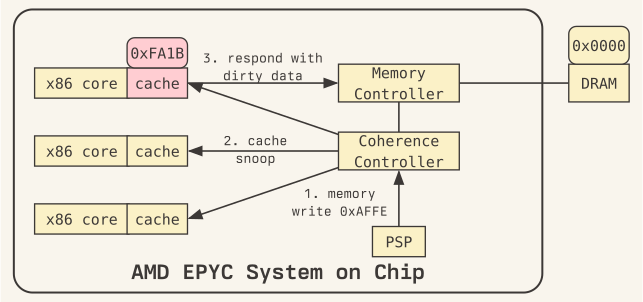
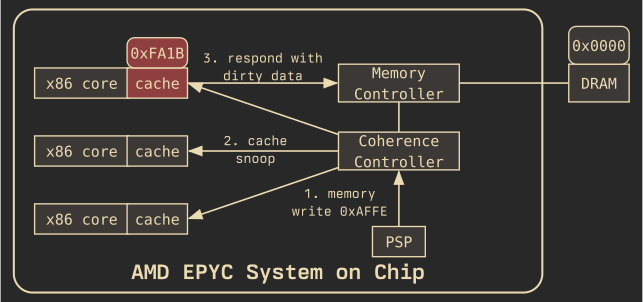
AMD enforces coherence through Coherence Controllers as shown in Illustration 1. When any components issues a memory request, the Coherence Controller broadcasts probe requests to all caches to check whether they cache the target data. If any cache holds a more recent copy of the requested line, it supplies that data directly, keeping all components in sync.
In the confidential computing threat model, the hypervisor is untrusted and potentially malicious. In Staleus, we identify that the platform exposes a security-critical configuration register. The configuration register controls the cache coherence attributes of PSP memory transactions. More importantly, we find that a malicious hypervisor can modify this register to assert the NoSnoop attribute on all PSP memory accesses, forcing the PSP to bypass cache snooping and read or write DRAM directly.
This allows the attacker to induce a split memory view: the PSP operates on stale DRAM data while x86 cores hold divergent, more recent values in their caches. Staleus exploits this divergence in two ways. First, when the PSP reads DRAM, it retrieves stale data that does not reflect recent x86 cache writes. Second, when the PSP writes to DRAM, a subsequent x86 cache eviction silently overwrites the PSP-committed data. We leverage these primitives to forge the Guest Context Page, a PSP-protected structure holding the CVM attestation report and GuestPolicy fields, enabling the hypervisor to activate debug mode on a production CVM and gain arbitrary read and write access to CVM memory.
In more detail, AMD Zen CPUs employ so-called bridges that translate between different bus protocols. The SYSHUB is one such bridge and serves as AMD’s architectural gateway for integrating third-party IP blocks into the Data Fabric. Among other functions, it converts standard AXI transactions into AMD’s proprietary Scalable Data Port (SDP) bus protocol. Our reverse engineering efforts reveal that the SYSHUB services multiple clients, all of which interface via an internal crossbar. Crucially, the PSP functions as one of these clients whenever it initiates access to the Data Fabric (e.g., targeting x86 DRAM). The SYSHUB is responsible for translating PSP AXI signaling into compatible SDP signals.
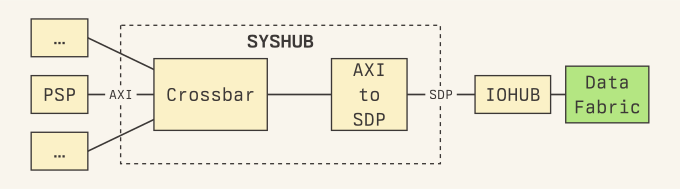
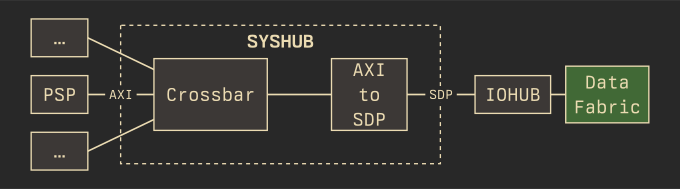 Illustration 3: Simplified data path for PSP memory requests.
Illustration 3 visualizes this data flow from the PSP through the SYSHUB to the Data Fabric. Because the translation from AXI to SDP is not a one-to-one mapping, and given that data and control signals possess differing widths, the SYSHUB must aggregate specific AXI data lines or synthesize new SDP-specific signals. The configuration for the SYSHUB exposes control bits that define how the cache coherence attributes propagate to the SDP interface. Modifying this configuration alters the memory coherence properties of the PSP with respect to x86 DRAM. PSP memory requests tagged with the NoSnoop attribute result in the transactions ignoring dirty data in residing in x86 caches.
Staleus operates as a software-only exploit with a 100% success probability. It does not require single-stepping, any specific code running inside the victim CVM, or physical access to the hardware.
We confirmed the vulnerability on AMD Zen 4 and Zen 5 EPYC processors running SEV-SNP. The two specific CPU models evaluated are listed below.
| Generation | CPU | Launched |
|---|---|---|
| Zen 4 | EPYC 9124 | 10/11/2022 |
| Zen 5 | EPYC 9135 | 10/10/2024 |
We informed AMD about the vulnerability in September 2025. AMD acknowledged the vulnerability and assigned CVE-2025-54509.
AMD acknowledged the vulnerability to be in scope and issued an advisory. Staleus was assigned CVE-2025-54509.
To cite our paper, please use the following BibTeX entry:
@inproceedings{schlueter2026staleus,
  title={{Staleus: Breaking AMD SEV-SNP via Memory Incoherence}},
  author={Benedict Schlüter and Shweta Shinde},
  booktitle={35th USENIX Security Symposium (USENIX Security 26)},
  year={2026},
  month = aug,
  address = {Baltimore, MD},
  publisher = {USENIX Association},
}